
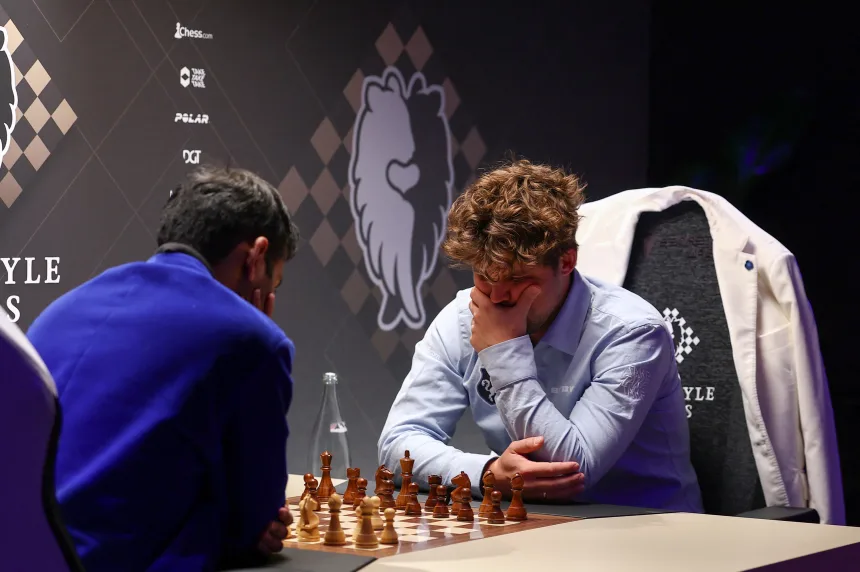
The world of chess has been going through somewhat of an evolution in recent years, and it’s showing no signs of slowing down.
The ancient game’s popularity boom has been well documented, owing in part to the rise of online formats during the Covid-19 pandemic and the reputational boost provided by mainstream media, such as the Netflix series “The Queen’s Gambit.”
Since then, chess’ move to online platforms has accelerated and its now currently debuting at the Esports World Cup (EWC) this week.
The tournament, hosted and part-funded by Saudi Arabia, was held for the first time in 2024 and brought together professional gamers, publishers and fans from across the world for an eight-week competitive gaming bonanza.
Earlier this year, it was announced that chess would be included in the 2025 edition, with the best players in the world competing for a $1.5 million prize pool – playing a new format which is deemed more accessible to an esports audience.
In a bid to compete in the new event, top esports teams set about signing some of the best chess players on the planet. Team Liquid, one of the biggest esports teams, didn’t hold back and signed Norwegian world No. 1 Magnus Carlsen, arguably the greatest chess player of all time.
Carlsen, who has also been an ambassador for the EWC, spoke to CNN Sports ahead of this year’s tournament about how the game can benefit in the digital era.
“I think this is a massive moment for chess,” he said. “Chess has become more and more online over the last few years, especially since Covid when we couldn’t host live tournaments.
“Online was what we had and those online tournaments became bigger and bigger, and it feels like this is the next step to have these hybrid events.”
While many players, including Carlsen, want to keep the traditional over-the-board chess alive, the transition to online platforms has coincided with changes in the game’s format.
With online games getting quicker, the goal for the EWC’s competition was to create a version which would stay true to tradition while incorporating elements associated with fast-paced esports games.
The result was the creation of a 10+0 format, which will give both players 10 minutes to make their moves without any chance to add additional time, increasing the chances of blunders as players battle against the clock.
The change, although radical when you compare to what the game was like less than 20 years ago, feels very natural to Carlsen.
“The funny thing about chess is that it is a bit of an ancient game and an analog game,” he said. “But it’s also kind of made for the digital age because it’s so simple to translate.
“Most of the time when I’m practicing chess, it’s always on a screen, whether it’s a phone, a computer or a tablet.
“Then when I get to tournaments, the pieces feel a bit strange and I don’t feel like I quite see the board the same way.”
Conclusion
Chess is proving it can thrive in both tradition and technology. Its entry into the Esports World Cup marks a new chapter, showing that the ancient game is perfectly suited for the digital age.